
Artificial Intelligence (AI) is changing the way businesses create content. From writing blog posts and social media captions to generating emails and advertisements, AI has become a valuable tool for marketers. It helps save time, improve productivity, and generate ideas quickly. But one important question still remains: Do people actually prefer AI-generated content or human-created content?
To find out, we recently conducted a small survey asking people about their preferences. Although the survey represents a small sample, the responses provide valuable insights into how people view AI-generated content today. The results clearly show that although AI is becoming more popular, people still value authentic and human-created content.
Why This Topic Matters
Content plays a major role in how businesses connect with their audience. Whether it’s a blog, social media post, email, or advertisement, every piece of content influences how people see a brand.
Today, businesses have more content creation tools than ever before. AI can generate content in seconds, making it an attractive option for marketers looking to save time. However, if readers feel the content lacks personality or authenticity, it may affect engagement and trust.
That is why understanding what people actually prefer is important before relying completely on AI for content creation.
Our Survey at a Glance
To better understand current perceptions of AI-generated content, we asked participants five simple questions comparing AI-assisted and human-created content. While the sample size was small, the findings offer useful insights into audience preferences.
The survey focused on:
- Whether people can identify AI-generated content.
- Which type of content they find more engaging.
- Whether AI-generated content affects trust in a brand.
- Why people prefer human-created content.
- Which platform they prefer for human-created content.
The responses revealed several interesting insights that businesses should pay attention to when creating content.
Survey Result 1: Can People Identify AI-Generated Content?
Our first question asked:
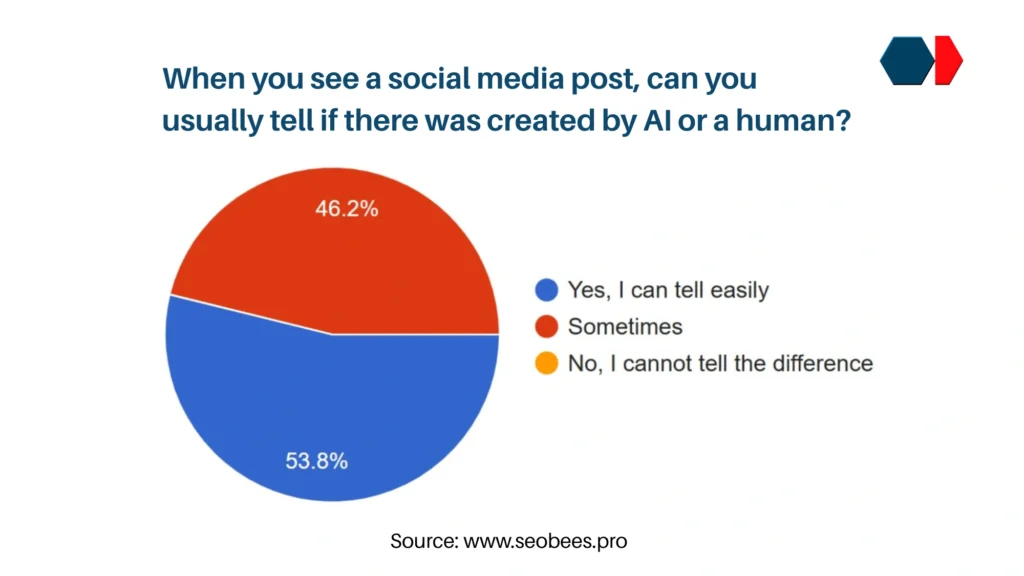
“When you see a social media post, can you usually tell if it was created by AI or a human?”
Survey Results
- 53.8% said Yes, I can tell easily.
- 46.2% said Sometimes.
- 0% said No, I cannot tell the difference.
What This Means
Every participant believed they could identify AI-generated content either consistently or at least some of the time.
This doesn’t necessarily mean AI produces poor content. Instead, readers often notice certain patterns such as repetitive wording, overly formal language, or a lack of personal experiences.
For businesses, this highlights an important point.
Simply publishing AI-generated content is no longer enough. Readers expect content that feels natural, useful, and relatable.
Adding human editing, real examples, and practical insights can make AI-assisted content much more engaging.
Survey Result 2: Which Content Is More Engaging?
Our second question asked:
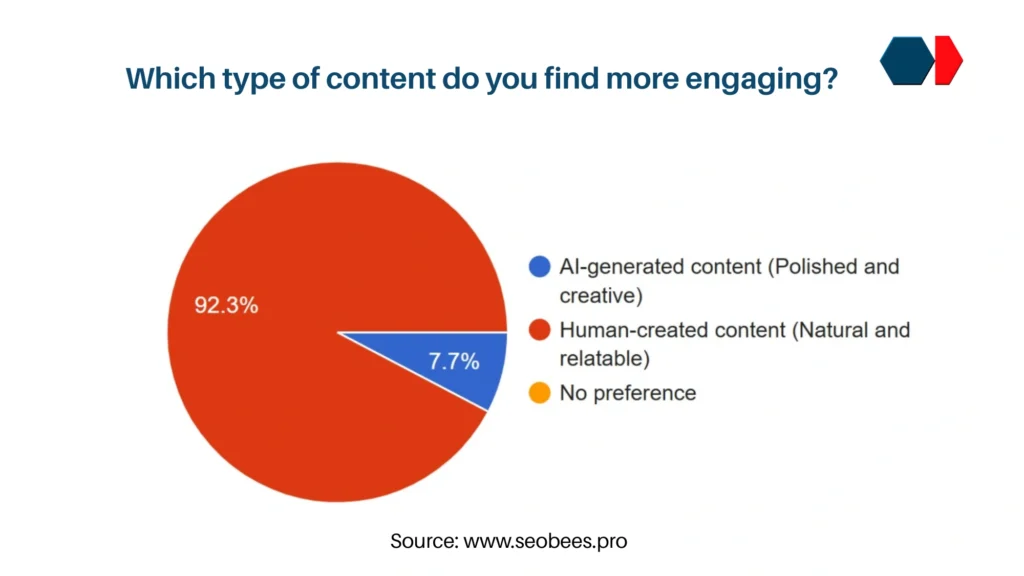
“Which type of content do you find more engaging?”
Survey Results
- 92.3% preferred human-created content.
- 7.7% preferred AI-generated content.
What This Means
any other word for strongest??
Almost every participant preferred human-created content over AI-generated content.
Why?
Because people naturally connect with stories, opinions, personal experiences, and emotions. Human-written content often feels more relatable because it reflects real experiences rather than simply presenting information.
For example, imagine reading reviews of two different restaurants.
One review simply lists the menu and prices, while another shares the atmosphere, friendly staff, favorite dishes, and personal experience. Most people would naturally connect more with the second review because it feels genuine.
The same principle applies to blogs, websites, emails, and social media posts.
Survey Result 3: Does AI Affect Trust?
Our third question asked:
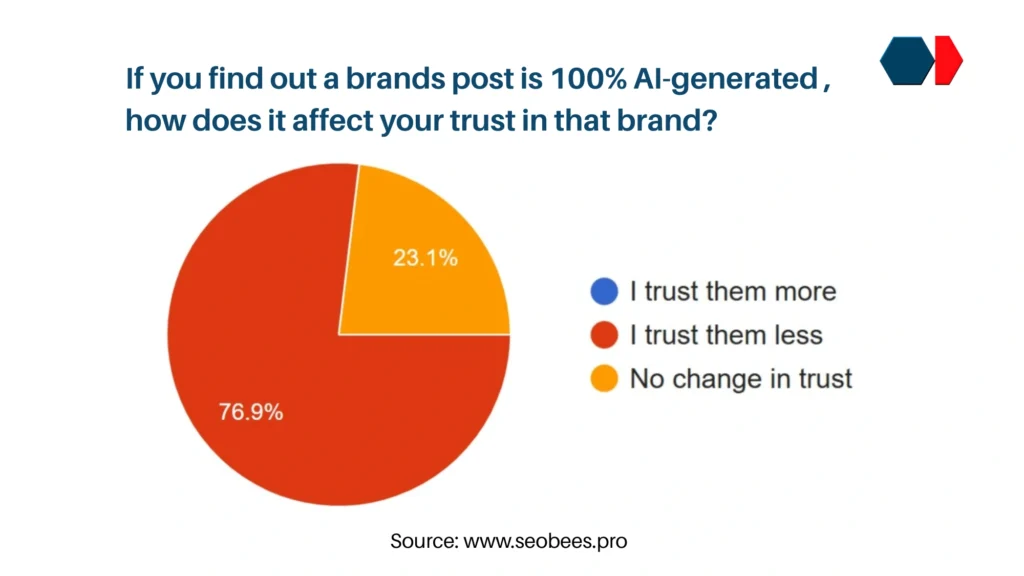
“If you find out a brand’s post is 100% AI-generated, how does it affect your trust in that brand?”
Survey Results
- 76.9% said they would trust the brand less.
- 23.1% said it would make no difference.
- 0% said they would trust the brand more.
What This Means
Trust is one of the most valuable assets a business can build.
Our survey suggests that many people may become less confident when they discover a brand relies entirely on AI-generated content.
This doesn’t mean businesses should avoid AI completely.
Instead, it shows that people still appreciate content that includes human knowledge, original ideas, and genuine experiences.
Businesses should think of AI as a helpful assistant rather than a complete replacement for human creativity.
Survey Result 4: Why Do People Prefer Human-Created Content?
To better understand people’s opinions, we asked another question:
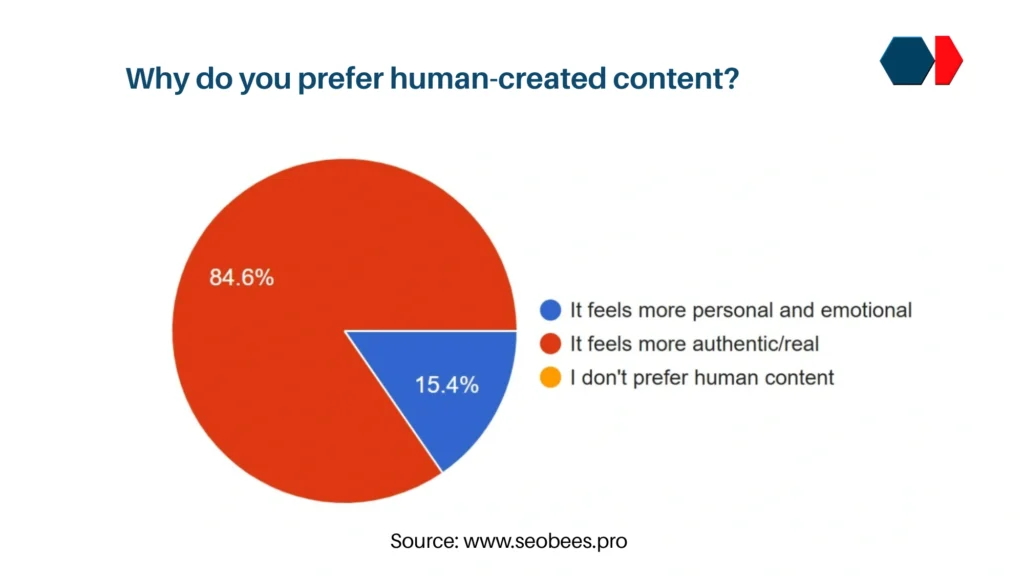
“Why do you prefer human-created content?”
Survey Results
- 84.6% said it feels more authentic and real.
- 15.4% said it feels more personal and emotional.
What This Means
This result helps to explain why human-created content remains so popular.
People want content that feels honest and natural.
They appreciate content written by someone who understands their challenges, shares practical advice, and communicates in a conversational way.
This doesn’t mean AI cannot help with content creation.
Instead, it suggests that businesses should combine AI with human editing to create content that is both informative and authentic.
Survey Result 5: Which Platform Do People Prefer for Human-Created Content?
Our final question asked:
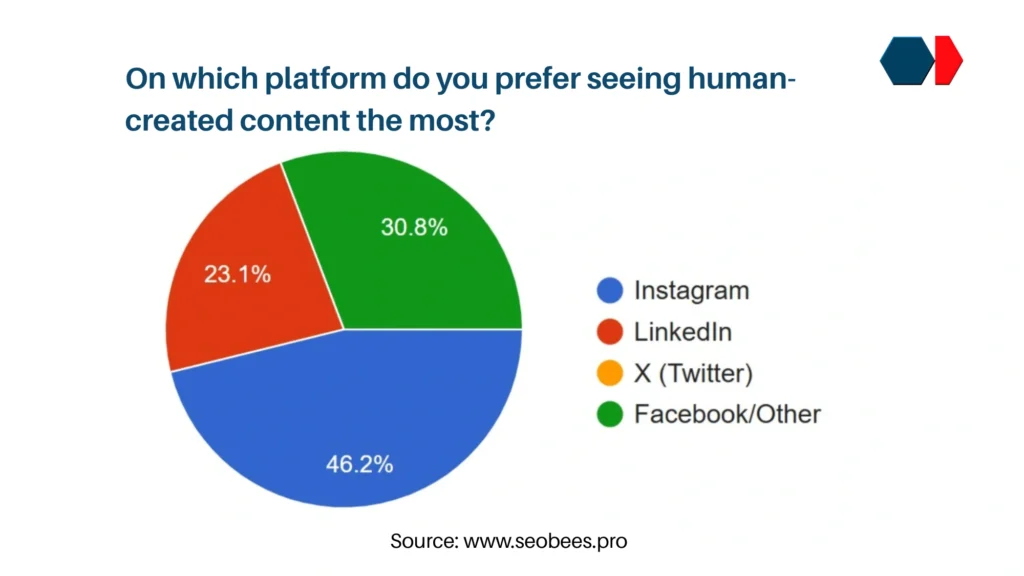
“On which platform do you prefer human-created content the most?”
Survey Results
- 46.2% chose Instagram
- 23.1% chose LinkedIn
- 15.4% chose Facebook
- 15.4% selected Other
- 0% chose X (Twitter)
What This Means
Instagram received the highest number of responses, showing that people enjoy authentic and engaging content on visual platforms. LinkedIn also received a good number of votes, indicating that professionals still value original insights and personal experiences over generic content.
The results suggest that regardless of the platform, audiences appreciate content that feels genuine, helpful, and written with real people in mind.
What Businesses Can Learn from This Survey
Although this survey included a small group of participants, the responses reveal an important message.
People are not against AI. Instead, they want content that feels useful, trustworthy, and authentic.
Businesses can use AI to improve efficiency, but they should always review and personalize the content before publishing it.
Some simple ways to achieve this include:
- Add your own experiences and insights.
- Include real customer stories or case studies.
- Use a natural and conversational tone.
- Review AI-generated content for accuracy.
- Focus on solving real customer problems instead of simply publishing more content.
By combining technology with human creativity, businesses can create content that builds stronger relationships with their audience.
Should Businesses Stop Using AI?
The simple answer is No.
AI has become a valuable tool for brainstorming ideas, creating outlines, writing first drafts, improving grammar, and speeding up content production. It can save measurable time and help marketing teams work more efficiently.
However, our survey shows that people still value authenticity and trust. Publishing content without reviewing or adding a human touch may reduce engagement and make your brand feel less personal.
The best approach is to let AI handle repetitive tasks while people focus on creativity, storytelling, and building meaningful connections with customers.
When used this way, AI becomes a powerful assistant rather than a replacement for human writers.
Finding the Right Balance Between AI and Human Creativity
Businesses do not need to choose between AI and human-created content. The strongest results often come from combining both.
A balanced approach might look like this:
Use AI For | Let Humans Handle |
Brainstorming ideas | Sharing personal experiences |
Creating first drafts | Storytelling and creativity |
Grammar and language improvements | Building trust with readers |
Research assistance | Final editing and fact-checking |
Content planning | Understanding customer emotions |
This combination helps businesses save time while still creating content that feels natural, authentic, and engaging.
Why Authentic Content Still Matters
Search engines are becoming better at understanding helpful, high-quality content. More importantly, readers are becoming better at recognizing content that feels genuine.
Whether you use AI or not, your content should always:
- Answer real customer questions.
- Provide useful and accurate information.
- Be easy to read and understand.
- Reflect your brand’s personality.
- Offer value instead of simply filling space.
Google also recommends creating people-first content that focuses on helping users rather than only trying to rank higher in search results.
Conclusion
Our survey shows that while AI is becoming an important part of content creation, people still prefer content that feels authentic, trustworthy, and genuinely helpful. Most participants found human-created content more engaging and said they trust brands less when content is completely generated by AI without a human touch.
The biggest takeaway is that businesses don’t need to choose one over the other. AI works best when it supports human creativity rather than replacing it. Combining smart technology with real experiences, useful insights, and authentic storytelling creates content that connects better with your audience and builds long-term trust.
If you want to create content that attracts readers, builds credibility, and delivers better results, it’s important to develop a strong content marketing strategy that balances technology with human expertise.
Ready to create content that connects with your audience and grows your business?