
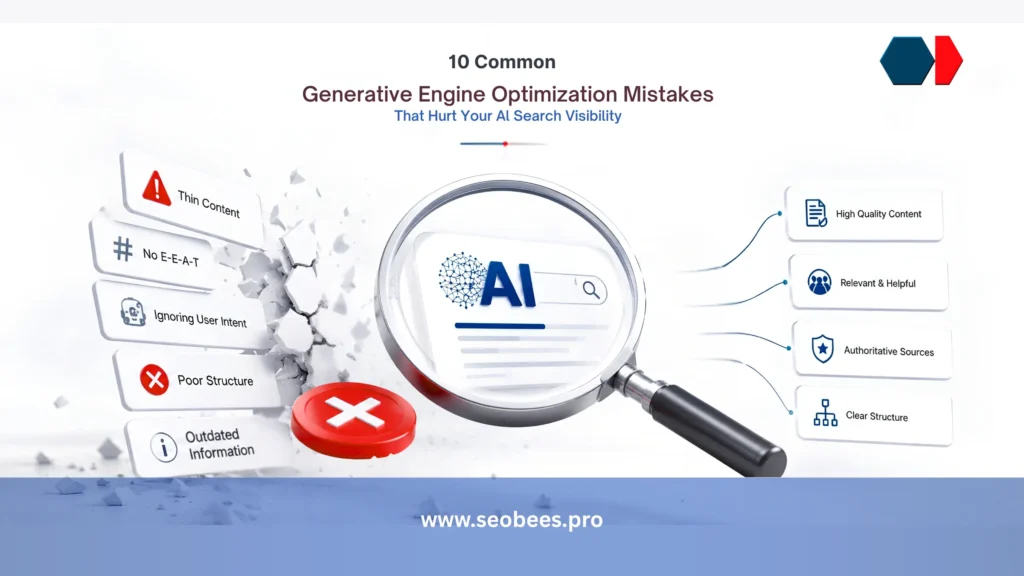
Every business wants its content to appear when people search online. But as AI-powered search becomes more popular, simply publishing articles is no longer enough. Many businesses invest time creating content, yet they unknowingly make mistakes that reduce their chances of being featured in AI-generated answers.
This is where Generative Engine Optimization becomes important. It helps businesses create content that AI can understand, trust, and recommend. However, even small mistakes can affect your AI search visibility and make it harder for potential customers to find you.
In this blog, we’ll look at some of the most common Generative Engine Optimization mistakes and show you how to avoid them so your content has a better chance of appearing in AI-powered search results.
Why Avoiding Generative Engine Optimization Mistakes Is Important
Optimizing content for AI search isn’t just about following the latest trend. It’s about creating content that answers real questions, demonstrates expertise, and builds trust with both readers and AI systems.
Even small mistakes can make it difficult for AI to understand your content or consider it reliable enough to recommend. By identifying these mistakes early, you can create stronger content that performs better in the future.
1. Treating GEO Exactly Like Traditional SEO
One of the biggest mistakes businesses make is assuming that Generative Engine Optimization works exactly the same as traditional SEO.
Traditional SEO focuses on helping your website rank higher in search results. GEO focuses on helping AI understand your content so it can recommend it when people ask questions.
For example, a page that ranks well on Google may not necessarily be mentioned by an AI assistant if it lacks clear explanations, helpful examples, or trustworthy information.
Instead of focusing only on rankings, think about whether your content genuinely answers the user’s question.
2. Publishing Content Without Original Insights
Many websites publish articles that simply repeat information already available online.
AI-powered search engines are becoming better at identifying content that adds little or no new value.
Instead of rewriting what everyone else has already said, try to include something unique, such as:
Original observations
Industry expertise
Customer success stories
Original research
Survey findings
Practical lessons learned from real projects
For example, if you’ve helped a client improve their website traffic or generate more leads, sharing that experience makes your content far more valuable than simply explaining a concept.
Original content helps your website stand out and builds credibility over time.
3. Ignoring AI Overviews and Answer Engines
Many businesses still optimize only for traditional Google search results.
However, more users are now finding answers through AI-generated summaries instead of clicking multiple websites.
If your content isn’t written in a way that’s easy for AI to understand, you may miss valuable opportunities to appear in these answers.
A good practice is to:
Answer questions directly.
Keep explanations simple.
Use descriptive headings.
Include supporting examples.
The easier your content is to understand, the more useful it becomes for both readers and AI systems.
4. Focusing Only on Keywords Instead of Topics
Keywords are still important, but AI search engines now understand context much better than before.
Instead of creating one article for every keyword variation, build content around complete topics.
For example, if your website focuses on Generative Engine Optimization, you should naturally cover related subjects like:
AI search
AI Overviews
Content quality
Website authority
Structured content
User intent
Covering related topics helps AI understand your expertise instead of viewing your content as isolated articles.
5. Forgetting to Build Brand Authority
AI doesn’t only evaluate what’s written on your website.
It also looks for signals that show your business is trustworthy.
These signals may include:
Positive customer reviews
Brand mentions on reputable websites
Guest articles
Industry awards
Business directories
Active social media profiles
Imagine two businesses offering the same service.
One has customer reviews, industry mentions, and published case studies.
The other has only a basic website.
AI is more likely to trust and recommend the business that demonstrates stronger authority across multiple platforms.
6. Ignoring Conversational Search Queries
People are no longer searching with just a few keywords. Instead, they ask complete questions using natural language, especially when using AI tools.
For example, instead of searching:
“Digital marketing agency Melbourne”
People are more likely to ask:
“Which digital marketing agency in Melbourne is best for small businesses?”
“How can I improve my website’s visibility in AI search?”
If your content only targets short keywords and doesn’t answer real questions, AI may struggle to recommend it.
Try to write naturally and include questions your audience is likely to ask. This makes your content more helpful and increases its chances of appearing in AI-generated responses.
7. Making Your Content Difficult for AI to Understand
AI can process large amounts of information, but it still benefits from content that is clear and well organized.
Some businesses publish long articles without proper headings, bullet points, or logical sections. This makes it harder for both readers and AI to understand the main ideas.
A well-structured article should include:
Clear headings and subheadings
Short paragraphs
Bullet points where appropriate
Simple explanations
Relevant images with descriptive alt text
Think of your content as a conversation. The easier it is to follow, the easier it is for AI to understand and recommend.
8. Forgetting to Show Who Created the Content
Trust is becoming more important in AI search.
Many businesses publish articles without explaining who wrote them or why readers should trust the information.
Adding credibility to your content can make a real difference.
Consider including:
An author name
A short author bio
Company expertise
Real business experience
Sources for important facts or statistics
For example, if you’re writing about digital marketing, explain your experience working with businesses and the results you’ve achieved. This helps readers and AI understand that your advice comes from real knowledge rather than generic information.
9. Not Monitoring How Your Content Performs
Publishing a blog isn’t the final step. Many businesses never review how their content performs after it goes live.
Monitoring your content helps you understand:
Which pages attract the most visitors
What topics people are interested in
Which pages need improvement
How users interact with your content
Tools like Google Search Console and Google Analytics can help you identify opportunities to improve your content over time.
Regular updates based on real data often lead to better long-term results.
10. Relying Completely on AI to Create Content
AI writing tools can help you brainstorm ideas, create outlines, and save time. However, publishing AI-generated content without reviewing it is one of the biggest mistakes businesses can make.
AI doesn’t know your customers, your industry experience, or your brand’s unique voice.
Before publishing, always:
Check facts and statistics.
Add your own insights.
Include real examples.
Make the language sound natural.
Ensure the information is accurate and up to date.
The best results come from combining AI with human expertise. AI can assist with content creation, but people should always review, improve, and personalize the final version.
Conclusion
AI search is changing rapidly, and businesses that adapt early will have a stronger chance of staying visible in the future. Avoiding these common mistakes isn’t about following another marketing trend, it’s about creating content that is genuinely helpful, trustworthy, and easy for AI and readers to understand.
Instead of focusing only on rankings, concentrate on providing real value through clear explanations, practical examples, and original insights. This approach not only improves your chances of appearing in AI-generated answers but also helps build long-term trust with your audience.
As AI-powered search continues to grow, investing in a strong GEO strategy can help your business create content that stands out, builds credibility, and remains visible across the next generation of search experiences.
Ready to prepare your website for the future of AI search? Book a Free Consultation with SEO Bees and discover how our team can help you improve your online visibility with effective Generative Engine Optimization strategies.