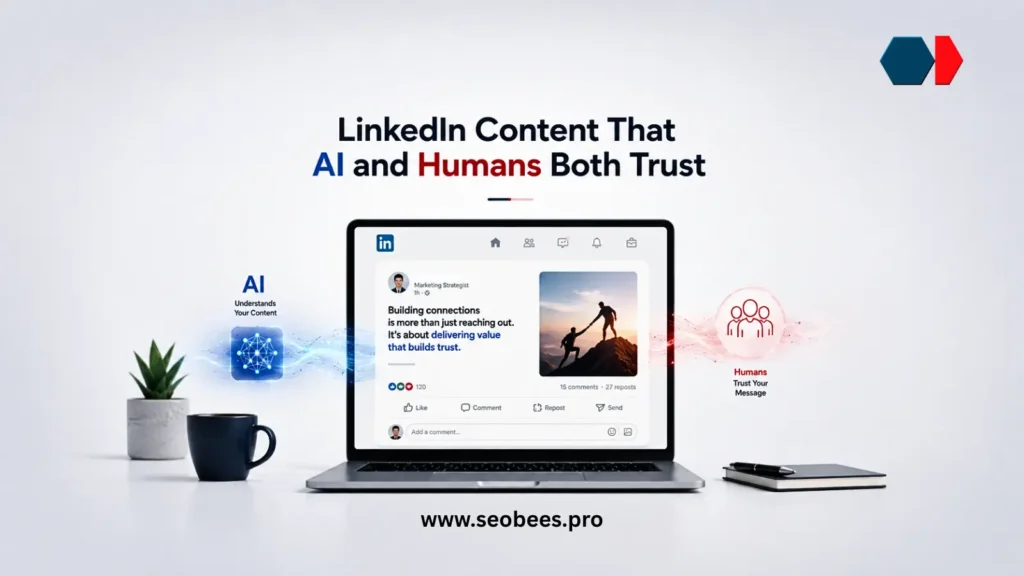
A good business post does more than appear in someone’s feed. It gives the reader a reason to stop, think, learn something, or take action.
This becomes even more important as AI changes how people discover information. Your content may now be seen not only by people scrolling through LinkedIn but also by AI-powered search systems looking for useful information to include in their answers.
That creates a new challenge for businesses. How do you create content that feels natural to a person while also being clear enough for AI systems to understand?
The answer is not to write for machines. It is to create clear, useful, well-organized content that has a real purpose.
In this blog, we’ll look at practical ways to create LinkedIn marketing content that can connect with people and remain easy for AI-powered systems to understand.
What Makes LinkedIn Content Worth Trusting?
Trust does not come from using complicated words or publishing something every day. It comes from giving people information they can understand and use.
Before publishing a post, ask yourself:
- Does this answer a real question?
- Is the information accurate?
- Can the reader learn something useful from it?
- Is the message clear?
- Can I support this information with an example or source?
For example, a digital marketing agency could simply post:
“AI is changing digital marketing.”
That statement is broad and gives the reader very little.
A stronger post could explain how businesses are using AI to analyze customer questions, find content ideas, improve ad copy, or understand search behaviour.
The second approach gives people something useful to take away.
Start With One Clear Idea
One common problem with business content is trying to explain too much in one post.
A better approach is to give each post one main idea.
For example, instead of creating one long post about AI marketing, create separate posts about:
- How businesses use AI for content research
- How AI can help improve customer targeting
- How marketers can use AI without losing their brand voice
- How AI is changing online search
- Common mistakes businesses make when using AI
This makes the content easier to follow and gives your audience a clear reason to engage with each post.
It also makes the topic easier for AI systems to understand because the page or post has a clear subject.
Use Specific Information Instead of General Statements
Specific information makes content more useful.
Compare these two examples:
General:
“Businesses should use social media to reach more customers.”
Specific:
“A local service business can use LinkedIn to share customer questions, project updates, industry tips, and useful answers that address common problems.”
The second example gives the reader a clearer picture of what they can actually do.
Whenever possible, include details such as:
- Real examples
- Numbers from your own research
- Customer questions
- Industry observations
- Practical steps
- Results from genuine campaigns
- Lessons from your own work
If you mention statistics, make sure they come from a reliable source. If the information comes from your own research or survey, clearly say so.
This makes your content more credible and gives AI systems clearer information to interpret.
Make Your Expertise Easy to See
Your audience should quickly understand why they should listen to you.
This does not mean filling every post with claims about being an expert.
Instead, show your knowledge through the information you share.
For example, a marketing agency can demonstrate expertise by explaining:
- Why a campaign produced a particular result
- What changed after testing different approaches
- What businesses commonly get wrong
- What the agency learned from working with clients
- Which strategy worked and why
This type of content gives your audience evidence of your knowledge instead of simply telling them that you have it.
Use a Simple Structure
A clear structure makes your content easier to read.
A useful format is:
Start: Introduce the problem.
Middle: Explain the idea or solution.
Example: Show how it works in a real situation.
End: Give the reader one useful takeaway.
For example:
Problem: Your website receives traffic but very few visitors become leads.
Explanation: The issue may not be traffic volume. Your landing page might not clearly explain what visitors should do next.
Example: Changing a vague “Learn More” button to a clear action such as “Book a Free Consultation” can make the next step easier to understand.
Takeaway: Before spending more money on traffic, check whether your website makes the next action clear.
This structure works well because the reader can quickly understand the point without searching through a large block of text.
Write Headlines That Explain the Benefit
Your headline or opening line should tell people what they can expect.
Avoid vague openings such as:
- “Here are some thoughts about marketing.”
- “AI is the future.”
- “Let’s talk about business growth.”
Instead, be specific.
For example:
- “Three ways AI can help small businesses find better content ideas”
- “Your website traffic is growing, but your leads are not. Here’s why.”
- “Before spending more on ads, check these five things on your landing page.”
Clear headlines help people understand the topic immediately. They also make it easier for search and AI systems to identify what the content is about.
Add Questions Your Audience Actually Asks
Questions can make your content more useful because they reflect the way people naturally look for information.
Think about the questions customers ask your business.
For a digital marketing company, these might include:
- How long does SEO take to show results?
- Does AI content help with SEO?
- How can I get more leads from LinkedIn?
- Should a small business use paid ads?
- How can I make my website appear in AI search?
You can turn these questions into individual posts, guides, videos, or FAQs.
This approach also supports Answer Engine Optimization (AEO) because your content directly addresses questions that users may ask search engines and AI platforms.
Keep Your Brand Voice Consistent
AI tools can help you create content faster, but your brand should still sound like your brand.
Imagine that a business normally communicates in a friendly and straightforward way. If its AI-generated content suddenly becomes overly formal and filled with complicated words, the audience may notice the difference.
Create a simple writing style for your business.
Decide whether your brand should sound:
- Friendly
- Professional
- Direct
- Educational
- Conversational
Then use that style consistently.
AI can help with drafting, but your final content should always be reviewed and adjusted to match your actual brand voice.
Turn One Idea Into Multiple Useful Pieces
You do not always need a completely new topic for every post.
One useful idea can become several pieces of content.
For example, if you publish a detailed article about AI marketing, you could turn it into:
- A LinkedIn post explaining the main lesson
- A short post answering a common question
- A customer example
- A simple checklist
- A short video script
- An infographic
- A discussion question
This saves time while allowing you to explain the same subject from different angles.
The important part is not to copy the same paragraph everywhere. Adapt the information to the format and audience.
Use Data Carefully
Data can make a post stronger, but only when it is reliable.
If you use a statistic, tell readers where it came from.
For example:
“According to our 2026 SEO Bees survey, respondents showed growing interest in AI-powered search.”
You can then link to the relevant survey insights so readers can explore the findings themselves.
This is much stronger than adding an impressive-looking percentage without explaining its source.
Original surveys, research, and first-hand findings can also give your business something valuable that competitors cannot simply copy.
Think Beyond the LinkedIn Feed
Your content does not have to stay on LinkedIn.
A useful LinkedIn post can lead people to:
- Your website
- A detailed blog
- A case study
- A service page
- A research report
- A survey
- A downloadable guide
This creates a connection between your social content and your wider digital presence.
For example, a short post can explain one useful marketing lesson and direct interested readers to a detailed guide on your website.
This approach gives your content a longer life and creates more opportunities for people to discover your business.
Make Your Content Easy for AI to Understand
AI-powered search systems need to understand what your content is about.
You can make this easier by:
- Using clear headings
- Answering questions directly
- Keeping one main topic per section
- Explaining industry terms in simple language
- Using relevant examples
- Supporting claims with trustworthy sources
- Keeping important information close to the topic it explains
This does not mean filling your content with keywords.
Instead, focus on clarity.
If a person can quickly understand what your content means, search engines and AI systems have a better chance of understanding it too.
Use AI as a Tool, Not the Author
AI can save marketers a lot of time.
You can use it to:
- Generate ideas
- Create outlines
- Find different angles
- Summarize research
- Improve readability
- Repurpose existing content
But there should still be a human review before anything is published.
Check the facts. Remove unnecessary sentences. Add your own examples. Correct anything that does not sound like your business.
Most importantly, do not publish information simply because an AI tool generated it.
Your reputation is attached to the final content.
A Simple Checklist Before You Publish
Before posting your next piece of LinkedIn marketing content, take a minute to check:
- Is the main idea clear?
- Does it solve a real problem?
- Is the information accurate?
- Have I included something specific or useful?
- Does it sound like my brand?
- Are any statistics properly supported?
- Is the structure easy to follow?
- Does the reader know what to do next?
If you can answer yes to most of these questions, your content is likely to provide much more value than a generic post created simply to fill your content calendar.
Frequently Asked Questions
1. How can I create LinkedIn content that feels more authentic?
Start with your own knowledge, experiences, and opinions. Use AI to help with ideas or structure, but add your own examples and writing style before publishing. This makes the content feel more natural and relevant to your audience.
2. Can AI help with LinkedIn marketing content?
Yes. AI can help you find content ideas, create outlines, improve readability, and repurpose existing content. However, you should review and personalize the final content so it accurately represents your business and expertise.
3. What type of LinkedIn content works well for businesses?
Useful content that answers customer questions, explains common problems, shares practical tips, or provides real examples can work well for businesses. Case studies, industry insights, how-to posts, and lessons from real projects are also good options.
4. How can LinkedIn content become easier for AI search to understand?
Use clear headings, simple language, direct answers, relevant examples, and reliable information. Keep each section focused on one idea and avoid unnecessary keyword repetition. This makes the content easier for both people and AI-powered search systems to understand.
Conclusion
Creating content that both people and AI can understand does not require complicated techniques.
Start with a clear idea. Explain it simply. Support it with useful information. Add real examples where possible and make sure your content reflects your actual expertise.
The role of AI in marketing will continue to grow, but businesses still need something technology alone cannot provide: a clear point of view and a genuine understanding of their audience.
A strong LinkedIn marketing approach should therefore combine smart technology with human judgment. Use AI to work faster, but use your own knowledge to make the final content worth reading.
If you want to improve your overall LinkedIn visibility, explore our guide on LinkedIn strategy to learn how LinkedIn and AI search can work together.
Ready to build a stronger digital presence? Book a Free Consultation with SEO Bees or connect with us on WhatsApp to discuss how we can help your business create better content and reach the right audience.